
A business automation audit maps where your practice is losing time to manual work, then ranks every fix by what it is worth and how fast it pays back. It is not a workshop. It is not a course. It ends with a costed, day-by-day plan, not a slide deck.
Most businesses that try to "do AI" fail within six months. Not because the tools don't work. According to Harvard Business Review, most AI initiatives fail not because the models are weak, but because organisations aren't built to sustain them. The tools were never the missing piece. The diagnosis was.
That's what an audit is for. This article covers what it involves, what it costs, who it's for, and why R5,497 buys more certainty than a free call ever will.
What a business automation audit actually is
Strip away the AI framing and it's a simple thing: a structured look at how your practice actually spends its hours, and a ranked plan for fixing the parts that waste the most of them.
It maps your real workflows, not generic ones. Lead handling. Client communication. Reporting. Billing. Compliance filing. Every task gets scored on an Impact-Effort basis: how much time or money it's costing you, versus how hard it is to fix.
The output isn't a list of AI tools to try. It's a ranked sequence: fix this first, this second, this third, and here's roughly what each one is worth in rands per year.
We call this the Business Automation Assessment. It's the same category of work the search term "business automation audit" describes, just under Cobus's own name. If you've searched that term, you're likely already past the "is AI even relevant to my practice" question and into "what does this actually involve, and is it worth paying for."
That distinction matters because most of what a professional services practice loses time to isn't glamorous. It's a partner manually copying figures from a bank statement into a spreadsheet because the reconciliation tool was never set up properly. It's a paralegal retyping the same letter of engagement with three fields changed. It's an advisor re-explaining the same FAIS disclosure by hand in every intake meeting because there's no template that auto-populates. None of that needs a chatbot. It needs someone to notice it, cost it, and sequence a fix. That noticing is the audit.
What happens during the audit, step by step
Before any of it, there's a free 5-minute scorecard: a short quiz that qualifies fit and shows you roughly where your practice sits, at no cost and no commitment. It's a lead magnet, not part of the audit itself. The paid audit only starts once you've decided to go ahead, and it runs in four stages from there:
- 90-minute intake call. Not generic questions. We map your actual workflows: how a lead becomes a client, how a report gets built, how billing happens, what compliance touches every file.
- Analysis phase (5 business days). The analysis structures everything into an Impact-Effort matrix, ranked by rand value and setup difficulty.
- Full written report. Every automation opportunity found, ranked, with specific tool recommendations, ZAR costs, setup times, and a day-by-day implementation sequence.
- 30-minute debrief call. A walkthrough of the findings together, not a report dropped in your inbox with no explanation.
Total elapsed time from intake call to finished report: about a week.
| Free Scorecard | Business Automation Audit | |
|---|---|---|
| Time | 5 minutes | About a week, start to finish |
| Cost | Free | R5,497 (refunded if it doesn't find R50,000) |
| What you get | Roughly where your practice sits | A ranked, costed, day-by-day plan specific to your practice |
| Depth | A quiz | 90-min intake + 5-day analysis + full report + debrief call |
The intake call is where most of the real work happens, and it's deliberately not a checklist.
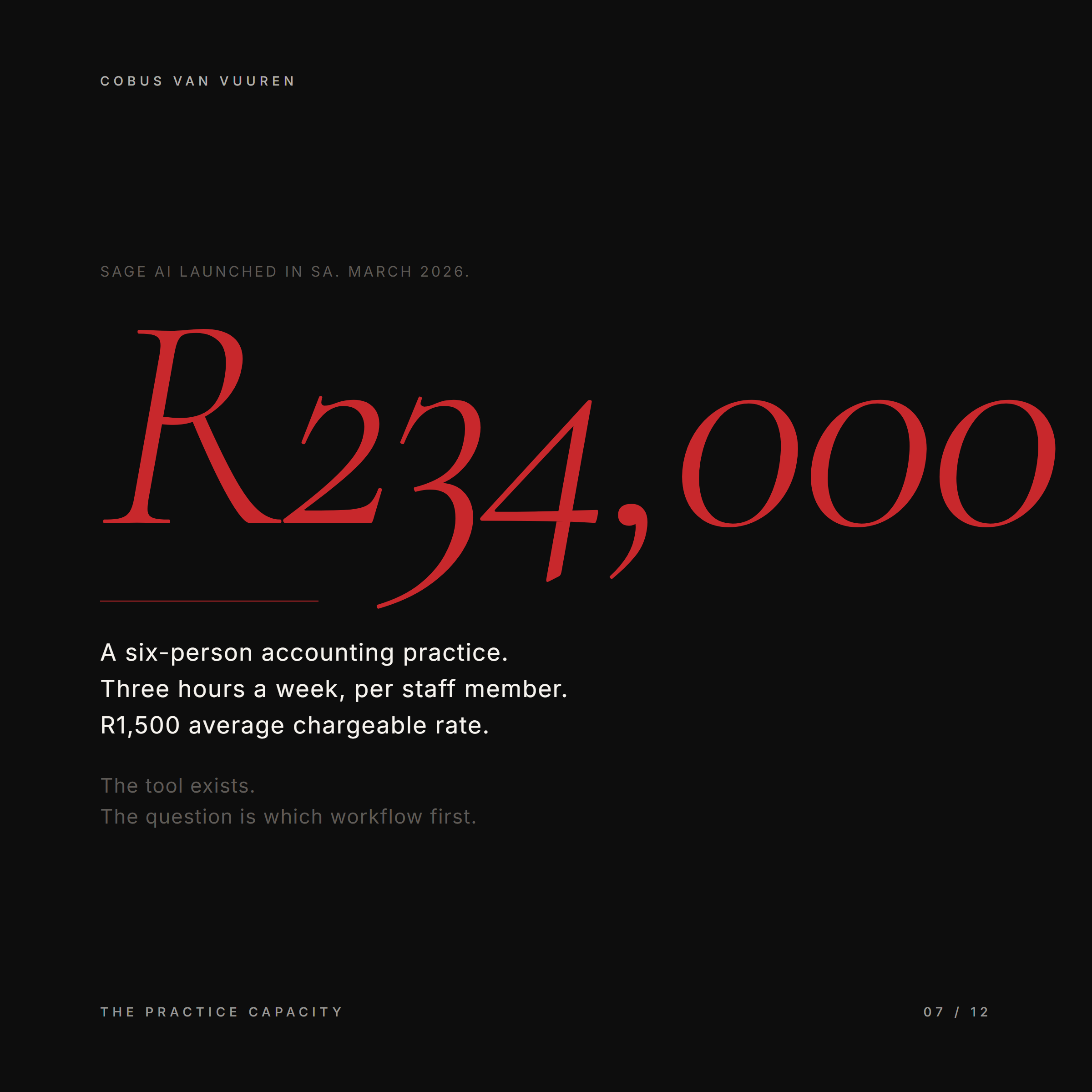
For an accounting practice, that means walking through how a new client actually gets onboarded, where FICA and SARS documentation sits, how month-end reporting gets assembled, and who chases outstanding information and how.
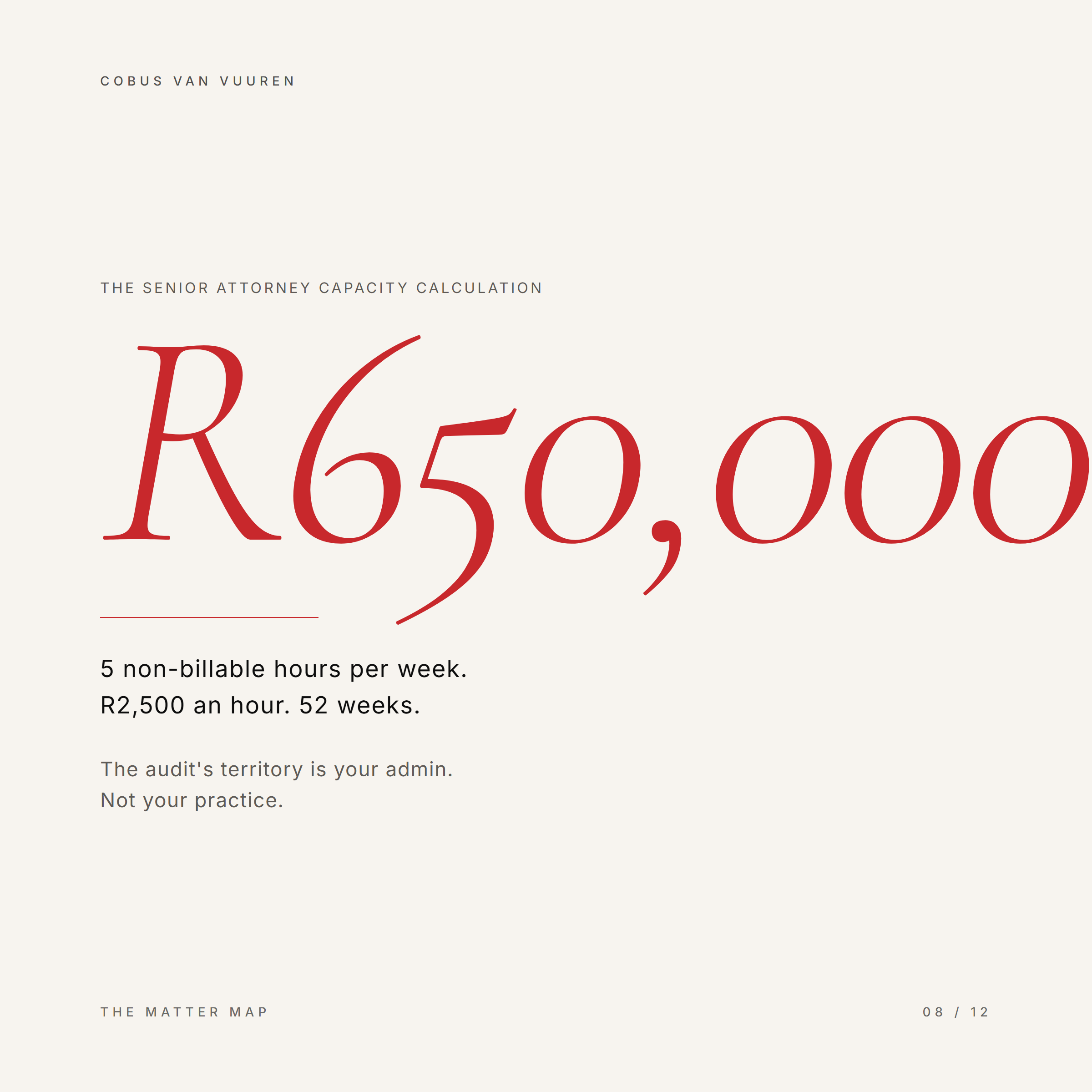
For a law firm, it means the matter map: which work happens at partner level, which at candidate attorney or paralegal level, and where the same document gets touched three or four times by three or four different people before it's filed.
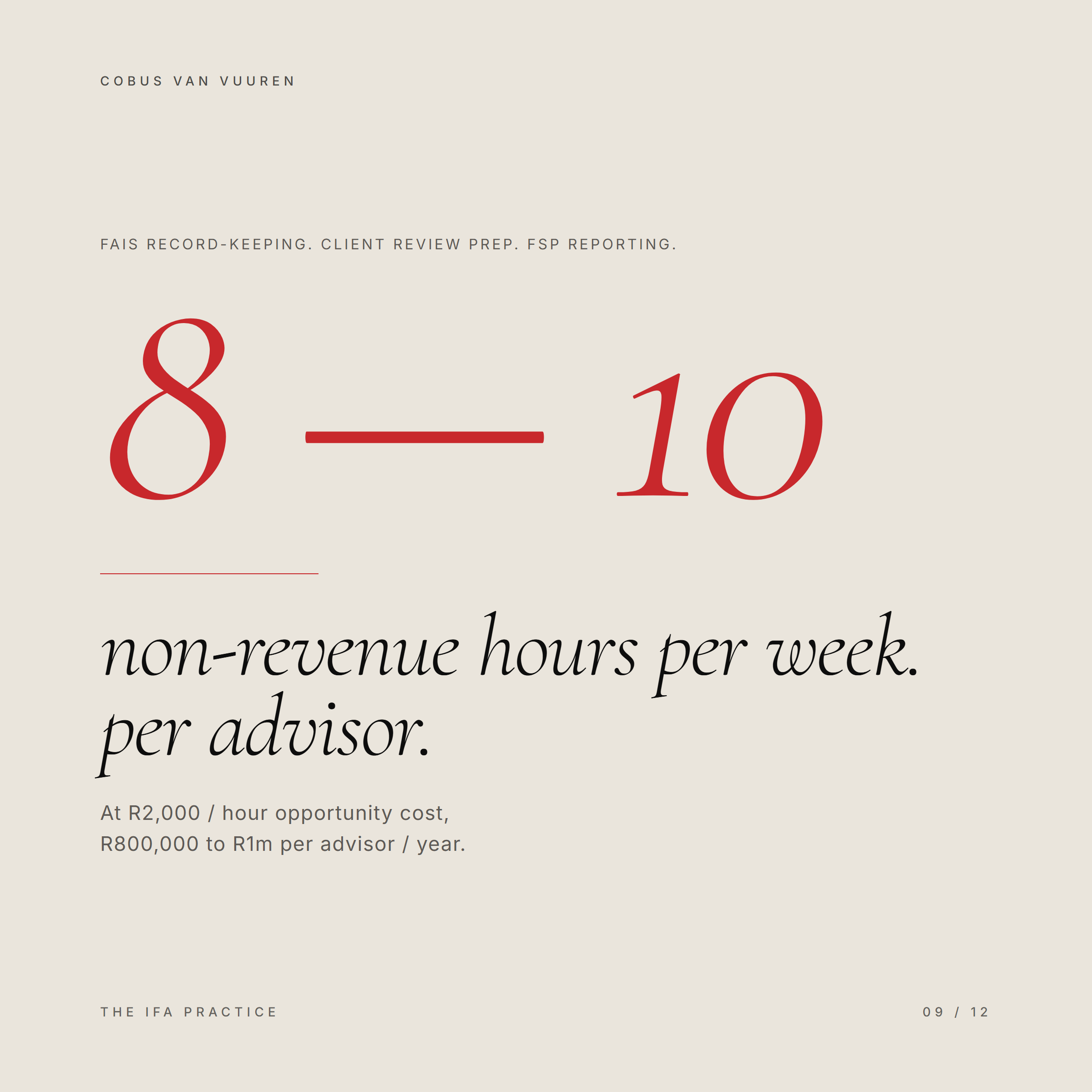
For a financial advisor, it means the FAIS record-keeping trail, the review-meeting cadence, and how much of the file prep before each client meeting is manual lookup versus automated pull.
None of that shows up in a generic questionnaire. It shows up when someone asks "walk me through what happened the last time you onboarded a client" and listens for where the friction actually is.
What you actually get at the end
Five things, specifically:
- A straight answer to "how should I use AI in my business?" Not a trend list or a tool roundup. Your own answer, specific to your practice, in priority order: what to do first, what to leave alone, and why.
- A ranked list of automation opportunities specific to your practice, not a generic industry list.
- Tool recommendations that work in South Africa. SA banking integrations, SARS-compatible filing, WhatsApp Business API, POPIA-compliant data handling. Not a US SaaS list that assumes Stripe and Slack.
- A day-by-day implementation plan a team member or a contractor can pick up and execute without needing you to explain it.
- A rand number. The audit is built to find a minimum of R50,000 in annual savings. If it doesn't, the fee is refunded. See the guarantee below.
This is the piece most audits from bigger consulting shops skip: SA-specific tool matching. A generic AI-readiness report written for a US mid-market firm will recommend tools that don't talk to SARS e-filing or don't have a WhatsApp integration at all. That gap is where a lot of the real Information Gain on this topic sits, and it's largely absent from what currently ranks for this search term.
In practice, that means the report names actual categories your practice already touches, matched to what that specific practice type runs on:
| Practice type | Accounting | Payroll | Meeting transcription | Client comms |
|---|---|---|---|---|
| Accounting firm | Xero, Sage | PaySpace, SimplePay | Fathom, Otter.ai | WhatsApp Business API |
| Law firm | n/a | PaySpace, SimplePay | Fathom, Otter.ai | WhatsApp Business API |
| Financial advisory | Xero, Sage | PaySpace, SimplePay | Fathom, Otter.ai | WhatsApp Business API |
Not because any specific tool is being pushed, but because the fix has to work with the systems your practice already runs on, not a stack it doesn't have.
Who this is for (and who it isn't)
This is for:
- SA professional services firms and agencies (accountants, attorneys, financial advisors, marketing agencies), anywhere a lot of time is lost to manual, repetitive computer work
- Companies with 3 to 50 staff
- Owners, directors, and CEOs who already feel the friction: the Monday catch-up, the same spreadsheet, the same manual reconciliation every month-end
- The ambitious employee too: a COO, CMO, or director who wants to get ahead of AI in their own role, not just fix the business's processes: sharper skills, better work quality, real time back
This isn't for:
- Tech startups (different problem, and not enough repeatable manual process to find R50,000 in)
- Businesses under 3 staff (not enough process volume yet to justify the fee)
If you're an accountant billing R1,500 an hour and still typing meeting notes by hand at 9pm, that's the profile this was built for. The audit assumes you're busy, not that you have spare hours to sit through a course on prompt engineering. It's built around the practice you already have, not the one a workshop imagines you might build.
Why R5,497 and not a free call
The guarantee answers this directly: if the audit doesn't find R50,000 in annual savings, you pay nothing.
Here's the maths behind why that's a low bar, not a marketing line. At a conservative R800 an hour, recovering just 10 hours a week of admin time returns the R5,497 fee in under a week. Most practices we've mapped are losing more than 10 hours a week to manual work across the whole team, not one person.
A free call can't produce that number. A free call is 20 minutes of conversation. It can't map five workflows, cost each fix in rands, and sequence an implementation plan. That takes the 90-minute intake, the 5-day analysis window, and a written deliverable. The fee funds the actual analysis time, not a sales conversation dressed up as one.
As an illustration of the maths, not a claim about a specific client: a two-partner attorney practice billing R2,000 an hour, where each partner loses roughly 6 hours a week to matter administration that a paraprofessional or a properly scoped automation could handle, is sitting on close to R1.2 million a year in recoverable capacity across the practice. The audit doesn't need to find anything close to that scale to clear the R50,000 guarantee. It needs to find about 4% of it.
There's also an international price anchor worth knowing. The same category of diagnostic, an AI or automation readiness audit, runs USD 5,000 to USD 50,000-plus in the US market, depending on business size: USD 5,000 to 15,000 for a mid-market firm, USD 15,000 to 50,000-plus for anything enterprise-scale. At current exchange rates, R5,497 works out to roughly USD 300. The price isn't an accident. It's set to make the decision easy for an SA practice this size, not to match what a Big Four consultancy would charge for the same category of work.
The assessment doesn't cost R5,497. It finds R50,000. The report is how you see exactly where it is.
Why "just use ChatGPT" misses the point
ChatGPT, Copilot, and a dozen automation platforms are already available to every business owner reading this. Availability was never the constraint. Cost isn't either. Most of these tools are R300 to R1,000 a month.
The real question is which of your specific workflows they'll actually improve, in what order, and what breaks if you sequence it wrong. A tool pointed at the wrong process doesn't save time. It just moves the manual work somewhere less visible, or creates a new problem: a client communication that goes out with the wrong tone, a filing that skips a compliance step nobody flagged.
This is where a lot of businesses that "already tried AI" get stuck. They bought Copilot or ChatGPT Plus, someone used it for a week to draft emails, and then it quietly stopped being used because nobody sequenced it against an actual workflow. The tool wasn't wrong. It was pointed at the wrong first problem, with no plan for what came after week one.
Most AI projects fail because of bad diagnosis, not bad tools.
That's the finding behind the HBR framework cited above, and it's consistent with what we see auditing SA practices directly. The tool is the last decision in this process, not the first. The audit exists to make that decision correctly, once, instead of by trial and error six times.
Frequently Asked Questions
What does an AI readiness audit involve?
A 90-minute intake call mapping your real workflows, five business days of analysis turning that into a ranked Impact-Effort matrix, a full written report with specific tools and ZAR costs, and a 30-minute debrief call. No generic questionnaire. The questions are shaped around your actual practice.
How long does an AI readiness assessment take?
About a week from the intake call to the finished report. The 5-minute scorecard beforehand qualifies fit; it doesn't count toward the audit timeline itself.
What is the ROI of a business automation audit?
The audit is built to find a minimum of R50,000 in annual savings, guaranteed. At a conservative R800-an-hour billing rate, recovering 10 hours a week of admin time alone returns the R5,497 fee in under a week.
What is the difference between an AI audit and AI consulting?
A business automation audit is a fixed-scope diagnostic: map the workflows, rank the fixes, hand over a plan, done in about a week. Consulting is ongoing, ad hoc, and open-ended, billed by the hour or the month with no fixed endpoint. The audit is the first step, and it's designed to make the consulting decision unnecessary for anyone who just wants the plan and can implement it themselves. It tells you exactly what to fix, in what order, before you pay anyone, including us, to help implement it.
How do I know if my business needs an AI audit?
If you're a professional services firm with 3 or more staff and you can name a task you or your team repeats every week that a system should be handling instead, that's usually enough signal. A second test: if you, the owner, are still the person everything routes through before anything gets done, that's the bottleneck the audit is built to find and remove. The free 5-minute scorecard is the lowest-friction way to check before committing to anything paid.
Is my data safe during the assessment?
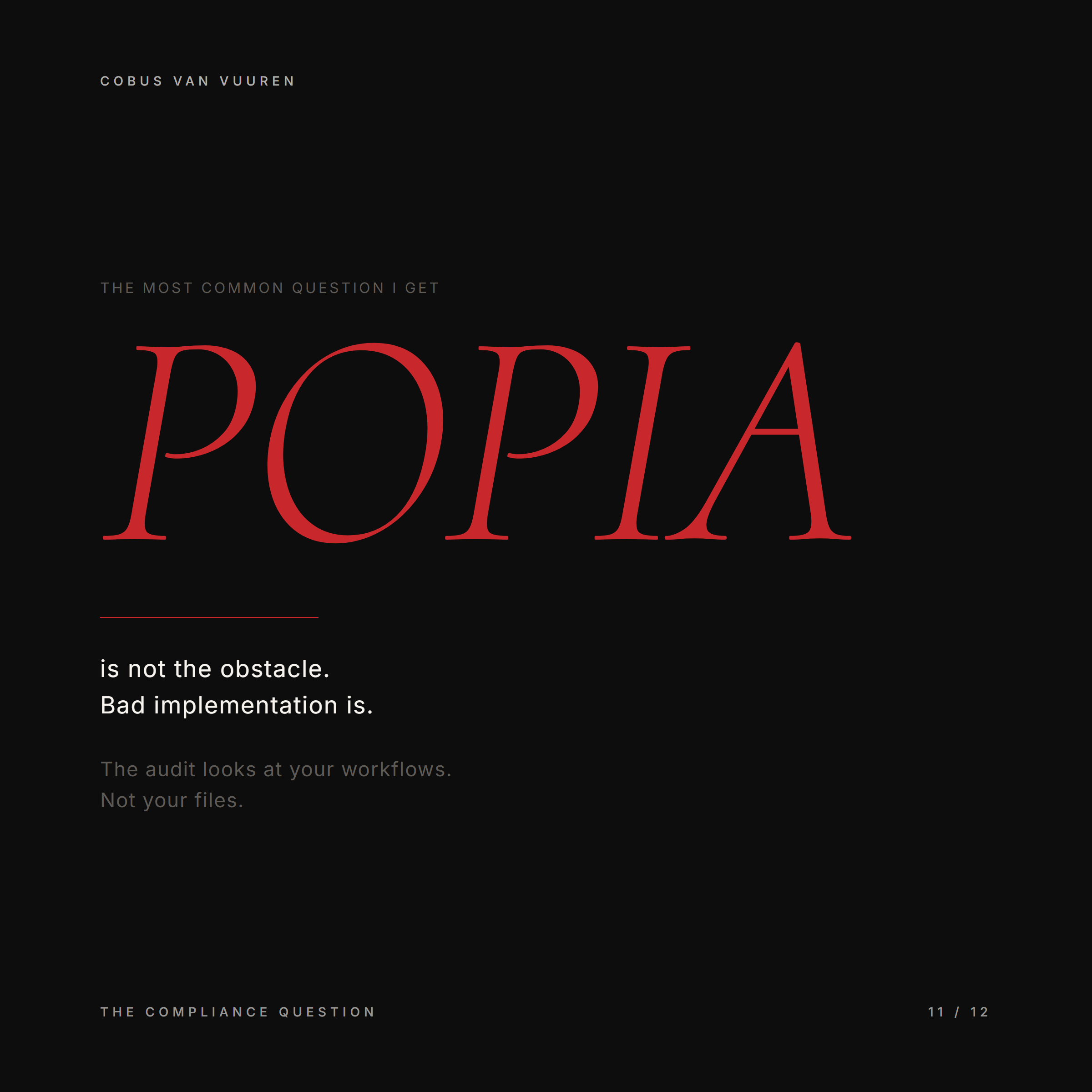
The audit is POPIA-compliant and works at the process level, not the data level. It maps how your workflows move information, not the client records themselves. You're not required to hand over client files for the diagnostic to work.
Do I have to implement everything the report recommends?
No. The report is ranked specifically so you can start with the single highest-impact fix and stop there if that's all you want to do. Nothing in the deliverable requires a follow-on engagement.
What if I already tried AI and it didn't stick?
That's useful data, not a failed experiment to be embarrassed about. The audit's first job is explaining why the earlier attempt didn't hold: usually a tool applied to the wrong workflow, or a rollout with no one owning it, and prescribing differently based on that.
Do you also do the implementation?
Yes, as a separate, scoped engagement once you've seen the plan. It's optional. Some practices hand the day-by-day plan to an internal team member or existing IT contractor instead, and that's a legitimate way to use it.
Take the next step
A business automation audit only works if you actually book one, so here are the three ways to do that, in order of commitment.
1. Free 5-minute scorecard. Qualifies fit before you spend anything, and tells you roughly where your practice sits today. Take the scorecard →
2. See the full breakdown. The guarantee, the FAQ, exactly what's included. No commitment. Read the assessment page →
Book the Assessment · R5,497 →