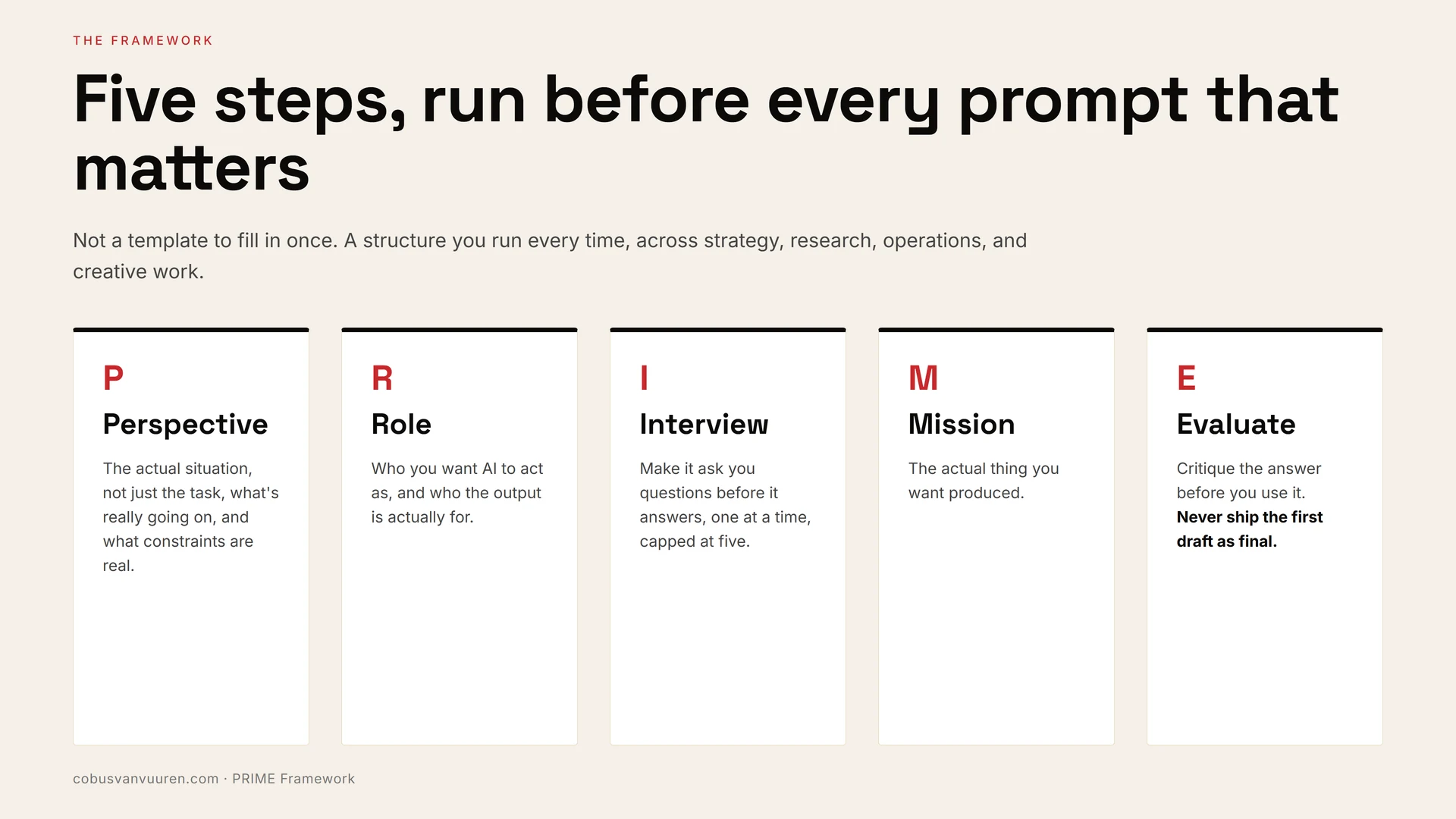
PRIME is a five-step structure for prompting AI that works across strategy, research, operations, and creative work, not just one. Most prompting advice teaches one trick for one kind of task. I got frustrated with that and that pushed me to find something that works on any situation and problem.
Prime your AI for better results
- Perspective: the actual situation, not just the task. What's really going on, and what constraints are real. Give it as much context as you can.
- Role: who you want AI to act as, and who the output is for. Not sure what fits? Ask AI directly in a separate chat, describe the situation, and use its answer.
- Interview: make it ask you questions before it answers. One at a time, capped at five.
- Mission: the actual thing you want produced.
- Evaluate: have the AI critique its own answer before you use it, not just you reviewing it afterward. Where possible, get an independent evaluation too, a second model reviewing the first one's work. Never ship the first draft as final.
Copy this and adapt it:
"[Perspective: the real situation and any constraints that matter]. You are [Role: the expert AI should act as], and this is for [who the output is for]. Interview me, ask one question at a time, up to five, before you answer. My mission: [the actual task]. Once you've answered: evaluate this against [a specific standard] before I use it, what's weak, generic, or unproven here?"
Or teach it once, and stop retyping the whole thing. Paste this into a new chat with whichever AI you use, and it'll apply PRIME by default from then on:
"From now on, use the PRIME framework for anything I ask that isn't trivial: Perspective (ask about the real situation and constraints before assuming), Role (confirm what role you should play and who the output is for), Interview (ask me up to five clarifying questions, one at a time, before attempting anything non-trivial), Mission (confirm the actual task before starting), Evaluate (critique your own answer, and flag anything you're not fully confident about, before giving it to me as final). Apply this by default unless I say otherwise."
Mechanics, plainly: this runs as one message, or as a short back-and-forth if the model actually asks its Interview questions rather than skipping straight to an answer. Interview stops once you've answered, or the model has enough to proceed, whichever comes first.
When it's overkill: a quick Slack reply doesn't need this. A client report, a pricing decision, anything with a real cost if it's wrong, does.
Why most AI prompt frameworks only work for one kind of task
CREATE (Character, Request, Examples, Adjustments, Type of Output, Extras) shapes one specific piece of output well. RISEN (Role, Instructions, Steps, End goal, Narrowing) suits a structured, stepwise task. Both work well in their lane. Pull either into a messy research problem, or an open-ended creative brief, and the structure stops fitting.
There's a second, quieter reason single-purpose frameworks stall out: they assume you're walking in with complete information. CREATE wants Examples and Adjustments up front, but sometimes you don't have an example yet, or you don't know the right adjustments. Sometimes you know the goal but not the steps. That's the framework's limitation, not yours, and it's exactly what Interview solves: asking for what's missing, instead of stalling until you show up prepared.
The four ways you actually use AI
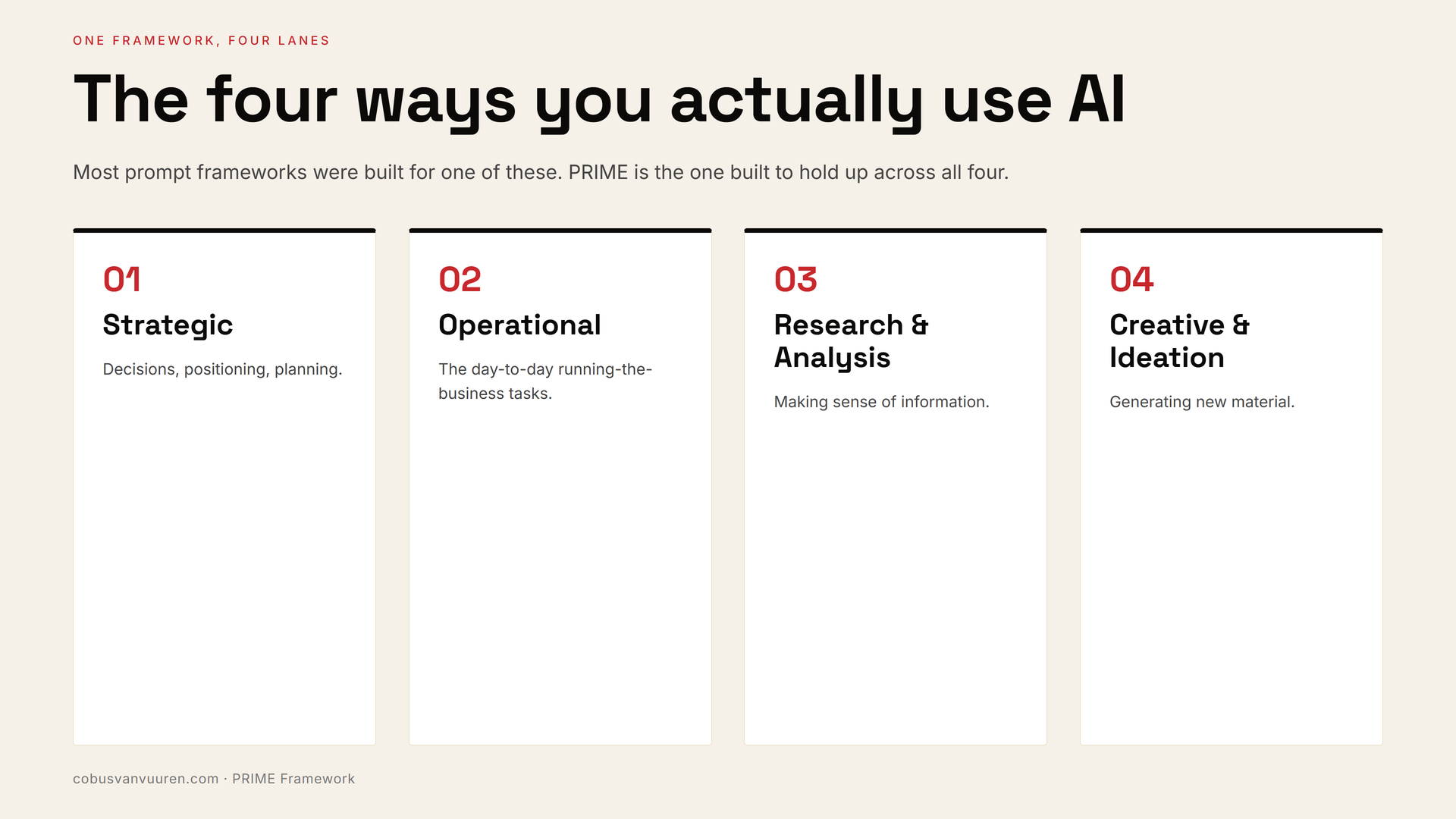
Every time I open an AI tool, the work falls into one of four modes: strategic (decisions, positioning, planning), operational (the day-to-day running-the-business tasks), research and analysis (making sense of information), or creative and ideation (generating new material).
These aren't airtight boxes, a compliance memo is research and operational and a little creative all at once. But mapping my own AI use into these four is what surfaced the actual gap. I run a file-based AI system across my agency, research, reporting, content, campaigns, and no single-purpose framework held up across all four modes. That's the structure I went looking for.
| CREATE | RISEN | PRIME | |
|---|---|---|---|
| Strategic | weak | weak | strong |
| Operational | weak | strong | strong |
| Research & Analysis | weak | weak | strong |
| Creative & Ideation | strong | weak | strong |
What AI actually gets wrong (and which step fixes it)
- It wants to please you. Left alone, AI defaults to agreeing with your starting point and validating your first idea, even a bad one. Ask it if your plan is good, and it will often just say yes. That's agreement, not intelligence. This is why Evaluate has to be deliberate, and why an independent second opinion catches what a self-review alone won't.
- It sounds equally confident whether it's right or wrong. A wrong answer gets the same tone as a correct one. There's no built-in "I'm not sure" unless you ask for it. Evaluate is where you catch this, before it costs you something.
- Without real context, it defaults to generic. A vague prompt gets you the most statistically average answer possible, technically true, useless in practice. That's what Perspective and Role are for.
- It doesn't know what it doesn't know about your situation. It will happily answer a question it doesn't have enough information to answer well, instead of asking first, unless you give it permission to. That's Interview's job.
- Ask it the same question twice, even in the same conversation, and you can get two different answers. Treat every first answer as a draft, and rework it, that's Evaluate again.
We've taken it even further: before finalising anything that actually matters, a genuinely independent AI model reviews the first one's work. Not the same model checking itself, a different one, with no stake in defending the original answer.
Part of our own operating system exists specifically for this: forcing genuine critique instead of agreement, before anything non-trivial ships.
Context is king, worth treating as a real investment, not a footnote. We take it seriously enough that helping businesses build a proper knowledge base, real context to draw on instead of whatever's in someone's head that week, is close to a service in its own right.
This is a big part of why so many businesses try AI, get a generic or overconfident answer, and conclude it doesn't work. The tool wasn't the problem. The prompt was.
How "Interview" changes what AI actually gives you
A recent one: working through a business plan with several moving parts, I had AI ask clarifying questions before committing to a sequence, rather than run with the first structure that looked reasonable. One question surfaced a real problem, the plan was about to add new work on top of something already overloaded. Caught before a single hour went into it.
Why "Evaluate" is the step almost everyone skips
Shipping the first draft as final is the default failure mode. I once had AI draft nine improvement proposals, then ran all nine past a second, independent model before building anything. It correctly killed three as over-engineering, more than the scale justified. Left unevaluated, a third of what I was about to build would have been waste.
A real Evaluate pass asks: does this actually solve the stated problem? Is it over-built for the scale? Would a skeptical colleague push back on any specific line? What's the failure mode if this is wrong?
What this looks like in practice
A fictional scenario, not a real client story, built from two real numbers: South African SMEs spend an average of 202 working days a year on admin (Sage-commissioned research by Plum Consulting, April 2025), and financial advisory practices specifically lose 8 to 10 non-revenue hours a week to compliance record-keeping and client review prep.
Picture a four-person financial advisory practice in Johannesburg. FAIS compliance documentation and client review prep are eating real weekly capacity. The owner knows it's a problem. There's no clear next step.
One note before the example: never paste a real client's name, ID number, or case-specific detail into an AI tool without approved data-handling controls. This scenario is fictional for exactly that reason, and so should any prompt you actually run.
Perspective: "I run a 4-person financial advisory practice in Johannesburg. FAIS compliance documentation and client review prep together eat roughly 10 hours a week across the team. We're not short on clients, we're short on capacity to serve the ones we have."
Role: "You're a systems consultant who's audited operational bottlenecks in regulated South African professional practices before. This is for me, the owner, not a report for my compliance officer."
Interview: "You can ask me up to three clarifying questions, one at a time, if anything here is unclear or you're uncertain about something before you answer."
Mission: "Give me a ranked list of the three highest-impact places to start, each with a rough time-savings estimate and what it would actually take to implement. Not a generic 'automate your compliance' answer."
Evaluate: "Once you've got a plan, evaluate it against established consulting frameworks before I use it, is this the highest-quality, most effective answer you can give, or is there a stronger one?"
Before and after: the actual outputs, not a hypothetical
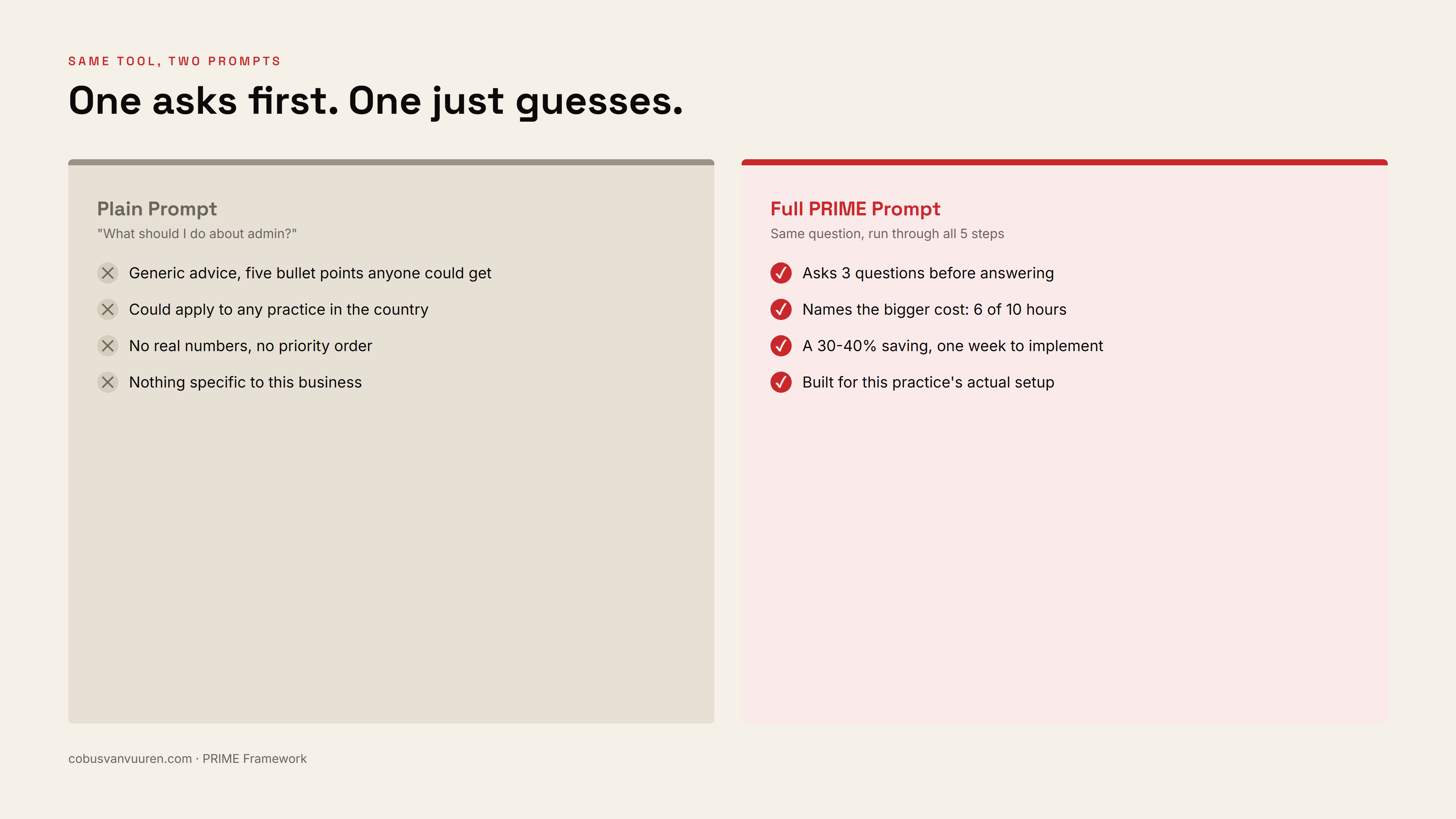
Plain prompt: "My financial advisory practice spends too much time on compliance admin and client review prep. What should I do?"
There are several ways to reduce time spent on compliance admin and client review prep: use practice management software to centralize client data and automate routine tasks, implement templates for common compliance documents, automate reminders via CRM, delegate admin tasks where possible, and regularly review your processes. Streamlining these areas frees up time for client relationships and high-value work.
True. Could apply to any practice in the country. Zero of it is specific to this one.
Full PRIME prompt (all five steps combined, per the template above), the model asks first, rather than answering blind:
Before I give you a ranked plan, three quick questions: 1) Of the 10 hours, roughly how much is FAIS documentation itself versus client review prep, or is it split evenly? 2) Is the practice using any practice management or CRM software already, or is this still fully manual? 3) Is the admin load spread evenly across the team, or does most of it land on you specifically as the owner?
Answer those (say: 6 of the 10 hours is review prep, a basic CRM exists but nothing built for compliance, the load is fairly even), and the plan looks like this:
Client review prep is the bigger cost at 6 of your 10 weekly hours, start there. Build a structured intake/review template inside your existing CRM, standardising what gets captured before each review, an estimated 30-40% saving, implementable in about a week with no new software. For the remaining ~4 hours of FAIS documentation, a template library for the most common record-of-advice scenarios cuts drafting time significantly, though it needs compliance sign-off, budget 2-3 weeks. Once both are running, a lightweight shared tracker prevents the same information being re-gathered twice, lowest priority, worth doing once the first two are bedded in.
Same tool. Same practice. A completely different, usable answer, because it asked before it answered.
Frequently Asked Questions
How do you structure a prompt for AI?
Five things, in order: the real situation, who the AI should act as, permission to ask you questions first, the actual task, and a critique pass before you use the output.
What are the components of a good AI prompt?
Context, a defined role, room for the AI to ask clarifying questions, a clear task, and a check on the output before you trust it.
What's the difference between a prompt framework and prompt engineering?
Prompt engineering is the broader skill of getting good output from AI. A framework like PRIME is a repeatable structure for doing it consistently, instead of reinventing the approach every time.
Can one AI prompt framework really work for every type of task?
Not every framework can. PRIME exists specifically because the common ones, CREATE and RISEN, each hold up in one lane and not the others. It's not that no single framework can generalize. It's that most weren't built to.
Start with your problem, not someone else's solution
Don't go looking for AI use cases to bolt onto your business. That's backwards, you'll end up chasing someone else's fix for a problem you never had. An automated invoice-to-accountant workflow is a great case study if invoicing was actually costing you time, and just noise if it wasn't.
If you had ten minutes with someone who'd read a few million books, would you spend it asking them to write your emails? You wouldn't. You'd bring them the thing keeping you up at night. That's the shift: most people use AI to polish work they already know how to do, instead of handing it the problem they don't know how to solve yet.
Take your own five biggest problems, the ones actually keeping you up at night, and run those through PRIME. See what it comes up with for your business, not someone else's demo. Reason from what's true about your situation, not whichever case study is trending, and you'll end up somewhere more useful than any borrowed use case would take you. The internet went through the same phase, endless hype, businesses copying whatever the loudest case study was doing, and the ones who did well worked out what it actually meant for them.
You're still the one responsible
AI is a tool. What it generates and what you use is still yours, the same as your name on a spreadsheet you built, not someone else's. You stay the thought leader, the custodian of the work. Rework the first draft rather than shipping it as-is, and never put something out under your name that you haven't stood behind.
One more thing worth being deliberate about: use AI to sharpen what you're already good at, not to paper over what you're weak at. Where you're an expert, you can judge whether its answer is good, push back on it, and get sharper. Where you're not, you can't tell if it's right, and you're laundering a guess as expertise. Go deeper where you already have judgment, don't fake judgment you don't have.
See where your own business is losing time
If you want a structured, scored version of the exercise above, running your own biggest problems through a proper framework, the free AI Readiness Diagnostic takes about five minutes.
Take the Free Diagnostic →