Finding an Afrikaans dictation tool works less like ticking a box and more like a two-round audition. Round one: can it handle plain, ordinary Afrikaans on its own, cleanly, no tricks? Most tools that claim Afrikaans support don't even clear that. Round two, the one almost nothing survives: can it keep up when you casually drop "client," "retainer," "approved" into the same sentence, the way you actually talk at work?
Not everyone dictates in a heavy English-Afrikaans mix. Plenty of practices run almost entirely in one language, with the occasional business term crossing over. But the first hurdle still applies either way: some tools that market themselves as Afrikaans-ready produce garbled output on completely normal Afrikaans, no code-switching required at all. Get past that, and the second hurdle is waiting. The moment you say "client" or "retainer" or "approved" inside an Afrikaans sentence, the tool has to guess. Locked to Afrikaans, it renders your English business terms as Afrikaans phonetics.
We went looking for a real answer: is there a tool that clears both hurdles? We tested one properly, on real bilingual speech. We scored it the way you'd want an auditor to score anything: with a method, a ground truth, and the failures written down alongside the wins.
Why "Does It Support Afrikaans" Is the Wrong Question
Every dictation tool's marketing page answers the same question: is Afrikaans on the language list? That's not useful, because it doesn't tell you which of the two hurdles above the tool actually clears. Plenty of tools tick the Afrikaans box on a feature list and still garble a plain Afrikaans sentence with zero English in it. That's a baseline quality problem, and it has nothing to do with code-switching yet.
Clear that hurdle, and the second one is still waiting. A model can genuinely handle clean Afrikaans well and still be locked into one language at a time under the hood, which is exactly when your English business terms get phoneticised instead of understood. Locked to English, the reverse happens.
That's the actual test for a bilingual professional. Not "does the app know Afrikaans exists." Does it survive the exact way you talk, first in plain Afrikaans, then in the mix you actually use at work.
None of the pages we checked ask either version of this question. ElevenLabs, Soniox and a string of transcription tools all publish a single Afrikaans accuracy number, scored on clean single-language audio, and leave it there. Nobody in that lineup tests code-switching. Code-switching is harder to market and harder to fake.
It's also genuinely hard to find a decent ("lekker") tool to even start testing. Most people just jump on whatever's trending, and right now that's Wispr Flow, which is a perfectly reasonable tool to have in the mix. It's fast, and it's popular for a reason. But Wispr Flow detects language once per session rather than word by word, so if your session drifts from Afrikaans into an English business term mid-sentence, it doesn't reliably catch the switch. Worth trying, worth keeping around, just verify it against your own real speech before you trust it with anything client-facing.
Not "does the app know Afrikaans exists." Does it survive the exact way you talk.
What Actually Breaks: The Highest-Value Words in the Sentence
Here's the part that makes this expensive rather than just annoying. The words that get mangled aren't filler. They're the client's name. The amount. Whether something was approved. In a matter note, an invoice email, or a WhatsApp to a colleague, those are the words your reader can't afford to have wrong.
A dictation tool that's 95% accurate overall can still be a liability if the 5% it gets wrong is always the same 5%: the embedded English term that carries the actual decision. Overall accuracy hides this. You need to know the hit rate on the words that matter, not just the average.
That's the number nobody was publishing, so we measured it ourselves.
We Tested It: 11.5% Word Error Rate, and What That Actually Means
We read a real 243-word passage aloud, mixing English and Afrikaans the way this ICP actually speaks, and ran it through Soniox's Afrikaans dictation engine, then scored the output against a hand-checked ground truth transcript.
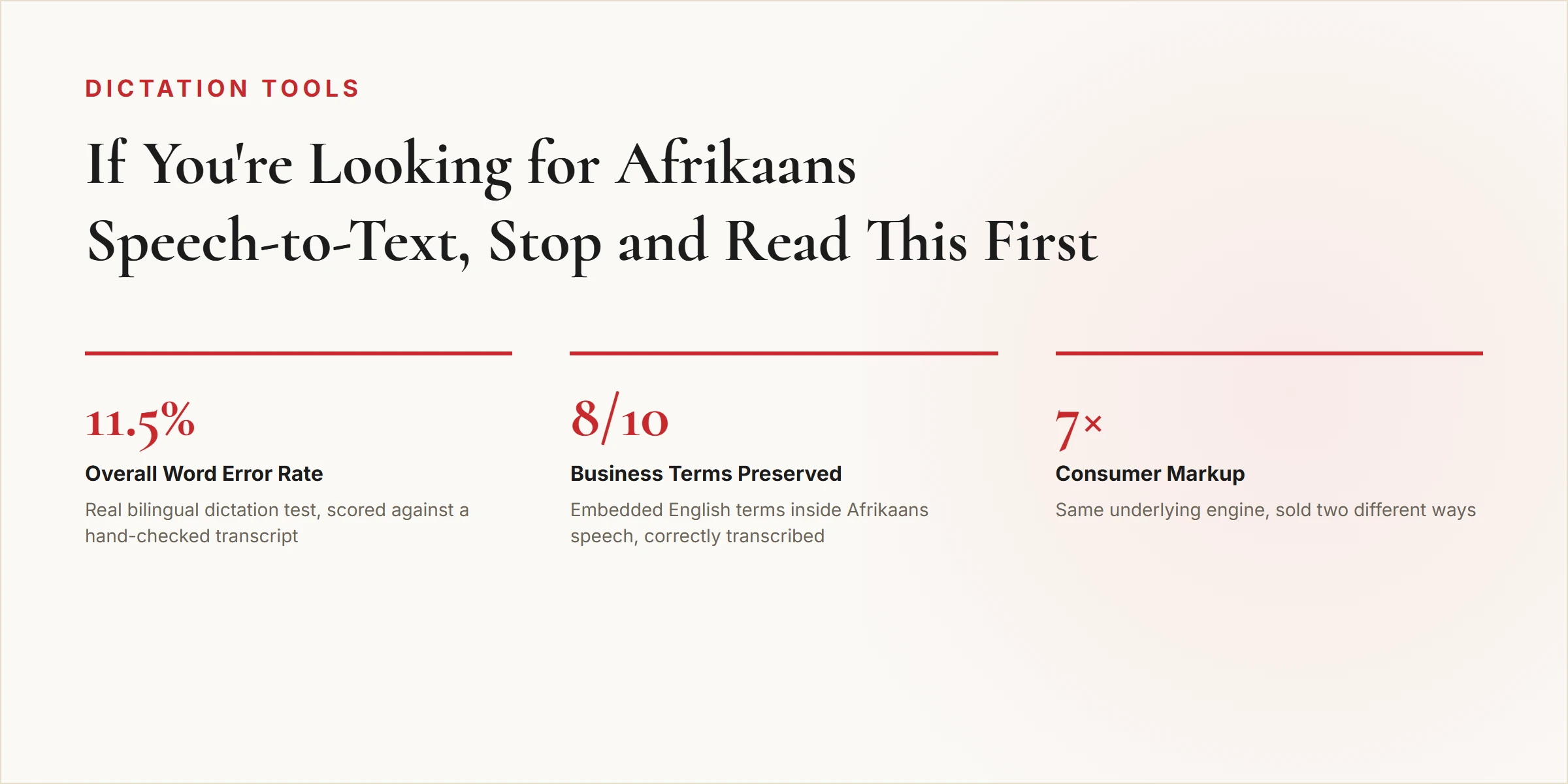
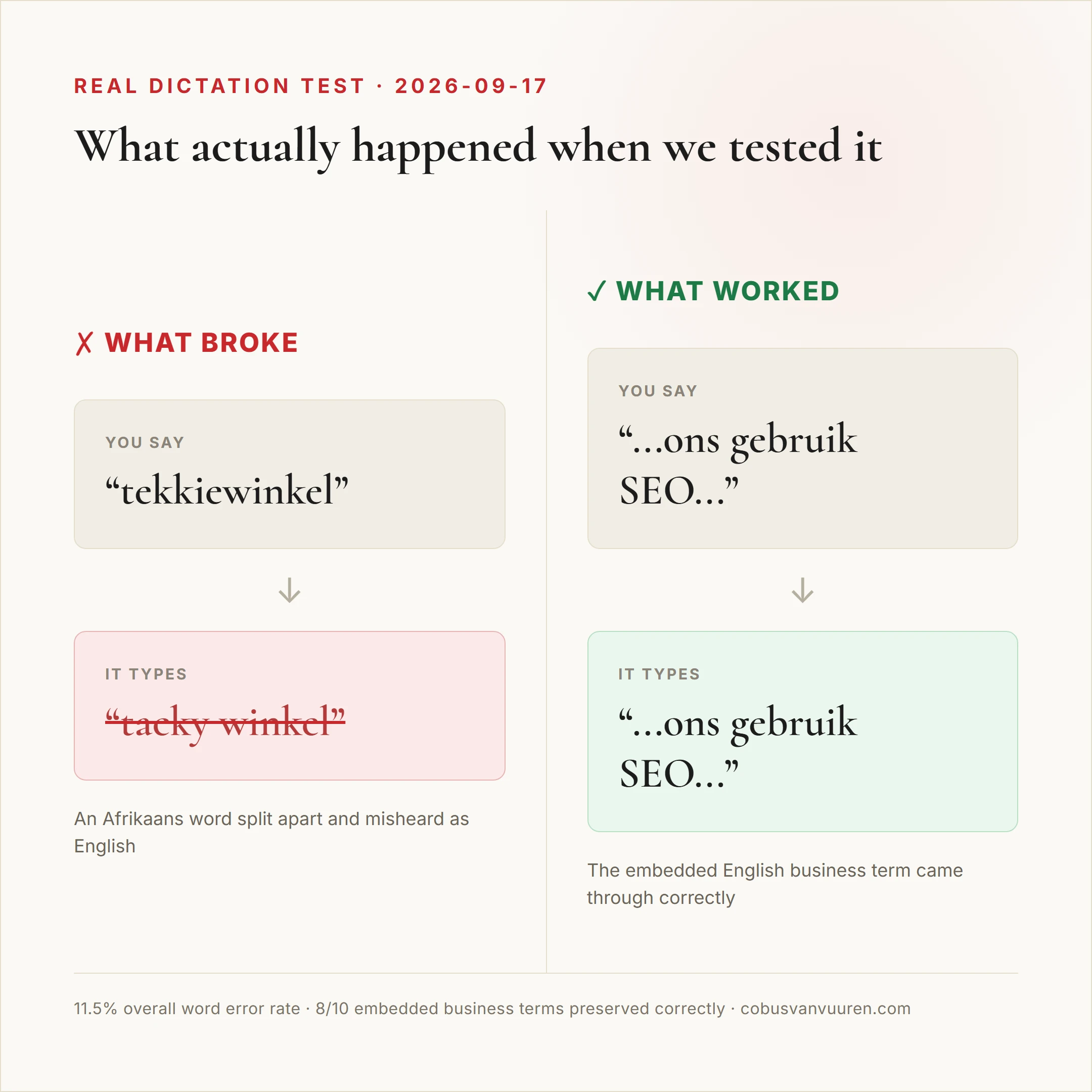
The overall word error rate came out at 11.5%, split 14.6% on the English-language sections and 9.3% on the Afrikaans-language sections. On its own, that number tells you almost nothing. What matters is the second score. On the specific mixed-language business and tech terms embedded in the passage, things like SEO, ChatGPT, Google AI Overviews and "search engine optimization," the tool got 8 out of 10 right.
Zero of those terms got Afrikaans-phoneticised into nonsense. That's the specific failure this whole test exists to catch, and it held up.
The One Place It Broke the Other Way
A test that only reports wins isn't a test, it's an advert. So here's the honest miss: the Afrikaans compound word "tekkiewinkel" (sneaker shop) got split apart and the first half came out as the English word "tacky." Same underlying problem, the per-token guess about which language you're in, just running in the opposite direction from the one everyone worries about.
It's a small error in a 243-word sample, not a pattern we'd bet a business decision on by itself. But it's the kind of detail that a vendor's own marketing page will never volunteer, and it's exactly why a single 243-word test, however carefully scored, is evidence, not proof.
Evidence is fine for a one-off decision about your own dictation habit. It's not fine if you're running this at production scale, say transcribing a call centre every week to generate coaching reports, training material, and content the way Nightjar does. At that volume, one wrong word doesn't cost you a re-read, it costs you a wrong number in every report downstream. That's the point where you want something close to 100% accuracy, not a single verified sample.
Confidence in the finding above: real dictation, real scoring, one sample, not a statistically powered benchmark.
The Vendor Number You Shouldn't Trust
While we were checking who else had actually tested this, we ran into ElevenLabs' headline claim of a 3.1% Afrikaans word error rate. It looks precise. It isn't specific.
The identical 3.1% figure appears verbatim on their English, Dutch, and Arabic pages. Afrikaans doesn't even appear on their own list of languages under 5% error. That's not an Afrikaans number. It's a template number with "Afrikaans" typed into the page around it.
That's not an Afrikaans number. It's a template number with "Afrikaans" typed into the page around it.
This is the pattern across almost every result you'll find searching for Afrikaans dictation software: vendor pages with a borrowed benchmark, batch transcription tools built for recorded audio rather than live typing, and one or two directory listicles with no testing behind them at all. Nobody in that search result set has published a code-switching test, which is the only test that actually answers your real question.
What This Actually Costs You
Here's where it gets interesting for anyone running the maths on their practice, because the accurate option and the expensive option turn out to be the same engine, sold two different ways.
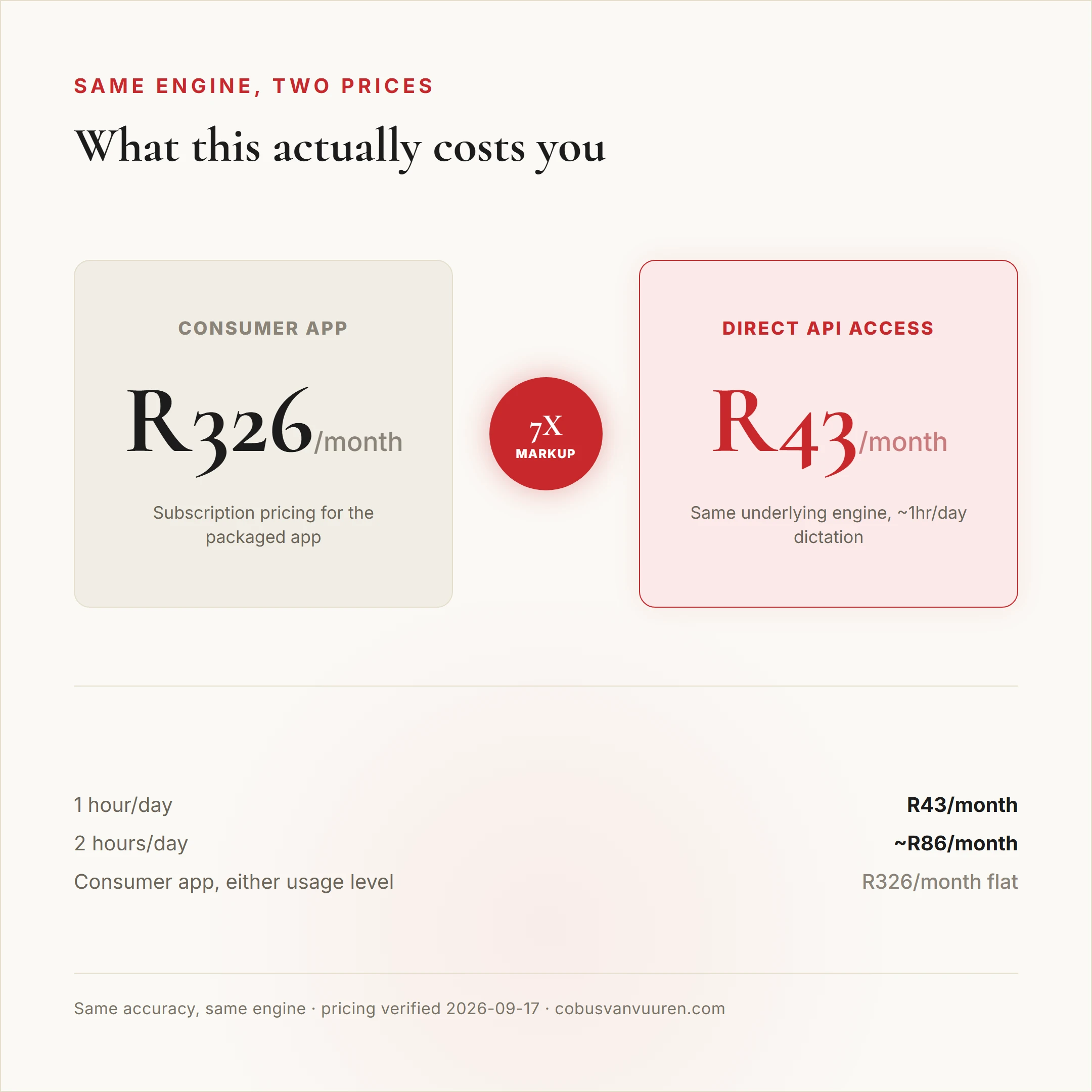
The consumer app subscription for the engine we tested runs about R326 a month. The same accuracy, reached through direct API access at roughly an hour of dictation a day, runs about R43 a month. Two hours a day still only comes to around R86. That's not a small difference. It's a 7x markup for the packaging, not the underlying transcription quality.
If your practice already treats every recurring subscription as a line item worth interrogating (and this ICP does, per rand-for-rand billing habits), that gap is worth five minutes of setup time to capture.
One More Risk Worth Knowing About
Separate from the accuracy test, we found something worth flagging on its own: an AI transcription model (not the one recommended above) confidently invented fluent, entirely fabricated Afrikaans business dialogue when fed three seconds of pure silence. Twice, with two different made-up sentences, both delivered with total confidence.
That's not a code-switching problem. It's a different risk entirely: a dictation tool that hallucinates text into a client email during a moment of silence or background noise. Picture that fabricated line surviving into Friday's report because nobody double-checked it, then having to explain it in an uncomfortable Monday morning meeting. Worth checking before you trust any AI transcription tool with client-facing correspondence, not just this one.
What To Do With This
You don't need to become an ASR researcher to use this. Three things worth doing before you pick a tool:
First, don't trust a single-language accuracy number. Ask, or test yourself, what happens to embedded English business terms inside Afrikaans speech specifically.
Second, check whether you're paying consumer-app pricing for API-grade accuracy. The markup we found was 7x for identical underlying quality.
Third, treat any AI transcription tool's silence-handling as a real risk category, not an edge case, before it touches anything client-facing.
None of this is a reason to avoid AI tools in your practice. The tool is the last decision, not the first. Test the specific claim that matters to you before you build a workflow around it, the same way you'd want a client to test a claim you made to them.
Is this the kind of AI-adjacent decision your practice keeps putting off?
The free AI Readiness Diagnostic takes about five minutes and gives you a clear read on where AI is actually worth your time right now, not a generic checklist.
Take the Free Diagnostic →